The office
A short story about who works here, and why.

Just after midnight
The light is still on in the Beweislage office. Seven questions in mathematics lie on the desk. Seven files. One is closed. The others are waiting.
Again and again someone knocks and says: I have solved it. The Inspector listens. Then he asks four questions, always the same. Who claims it? Has a machine replayed the proof? Have experts understood it? Has the Clay Institute decided?
He never adds the answers up. Four questions, four answers, each on its own.

Why he is called Quod
Nobody knows his real name. Epsilon once asked him. “Quod,” he said. “That will do.”
Epsilon looked it up. Quod erat demonstrandum means: which was to be proved. A proof ends with these words. So the Inspector carries the ending in his name and waits for the rest.
On his lapel he wears an empty square. In books a filled square marks the place where a proof is finished. His stays empty until a case is really closed.
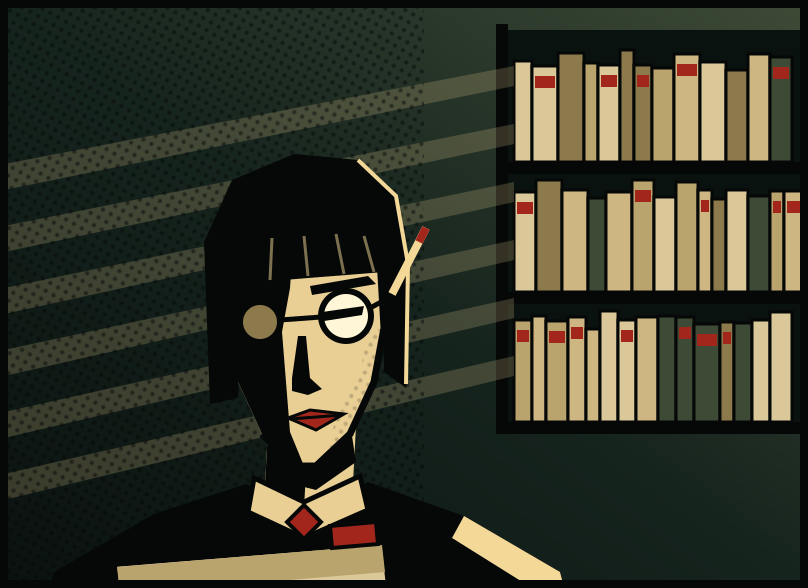
Madame Folio believes no one
The archive is her realm. With her, every entry gets a source and a date, even when it comes from the Inspector.
What she cannot back up, she does not write down. That leaves a gap, and the gap gets a label: not sourced. She prefers a gap to a guess.
They say she also keeps a file on the Inspector. Nobody has ever seen it.
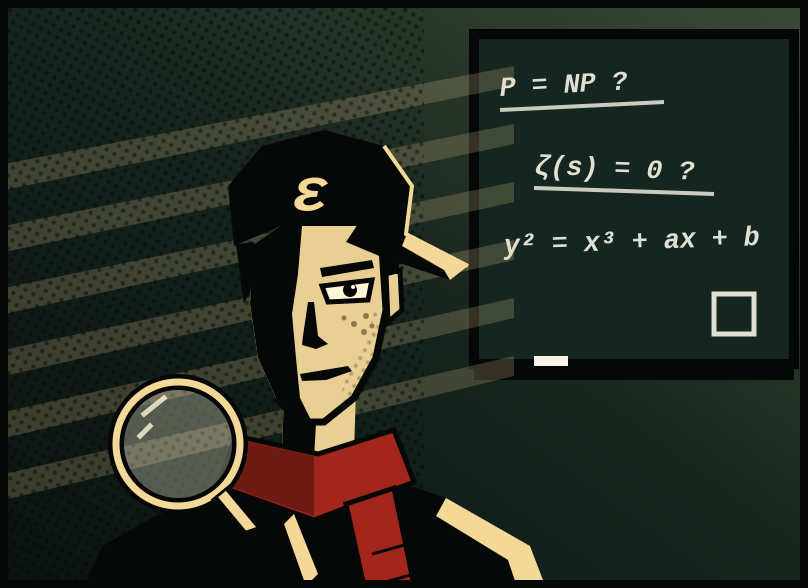
Epsilon keeps asking
Epsilon is the apprentice. In mathematics his name stands for something very small that still counts.
He asks until he understands. Then he explains it in two minutes, without formulas. Madame Folio says: if you cannot explain it in two minutes, you have not understood it yet.
That is why he has the first word in every file.
How the office works
The Inspector asks, Madame Folio provides the sources, Epsilon explains. The three do not decide whether a proof is right. They record who has checked what.
The office and its three characters are invented. What the files say is sourced.